
Libraries
Public Libraries and the Reading Room
The room came first, and the borrowing came later.
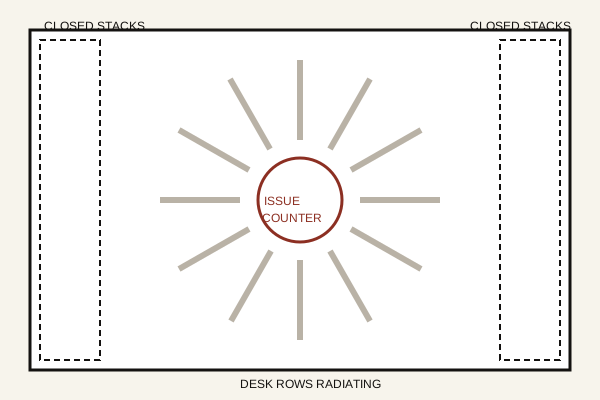
A public library is now understood mainly as a place that lends. Historically the lending was the late addition. The older institution is the reading room: a heated, lit, quiet space with tables, in which a collection that could not be taken away was consulted on the premises.
Why the room mattered
The reasons are physical before they are cultural. Books were expensive enough that a collection could not risk dispersal, and reading requires conditions that many homes did not supply: light after dark, warmth in winter, a flat surface, and enough quiet to hold a paragraph in mind. A reading room provided those conditions at shared cost. For a very long time the most valuable thing a library gave a reader was not the book but the two hours in which reading was possible at all.
The architecture followed the requirement directly. Reading rooms were built tall for daylight and for air, with desks arranged for supervision and for the shortest path to an issue counter. Where the plan radiates from a central desk, that is not symbolism; it is an attendant minimising walking distance while keeping every table in view.
Closed and open stacks
The great procedural division in library history is whether the reader may reach the shelf. In a closed-stack library the reader consults a catalogue, writes a request, and waits for a book to be fetched. In an open-stack library the reader walks into the collection.
Closed stacks protect the collection, permit dense shelving and make the catalogue the primary instrument of access. Open stacks accept some loss and some disorder in exchange for browsing, which turns out to be a distinct and difficult-to-replace way of finding things. Most readers cannot name the book they want; they can recognise it when the neighbouring spines put it in front of them. The shift towards open access is arguably the single largest change in what a library does, because it changed the library from a delivery service into a place you look around in.
Silence as a service
The reading-room silence that later generations found forbidding was a service specification. If the room's value is the conditions it supplies, then noise is a fault in the product. The rule was not primarily about reverence for books; it was about protecting the concentration that the room existed to make possible.
Contemporary libraries have largely reversed this, and for good reasons: they now supply group study, children's activity, machines, warmth and company, and those uses are noisy. The interesting consequence is that the original service has become scarce again. Quiet, lit, free, unsupervised space with a table is not widely available, and where libraries still provide it they are doing the oldest thing they do.
What the room was for
The reading room is worth remembering accurately because it clarifies what a library is. A library is not a warehouse with a lending policy. It is an argument that access to reading should not depend on owning books, owning a desk, or owning a quiet hour, and the room was the first and most direct form that argument took.