
Textbooks
The Hornbook and the First Classroom Page
One leaf, one board, and the whole of a child's first year of reading.
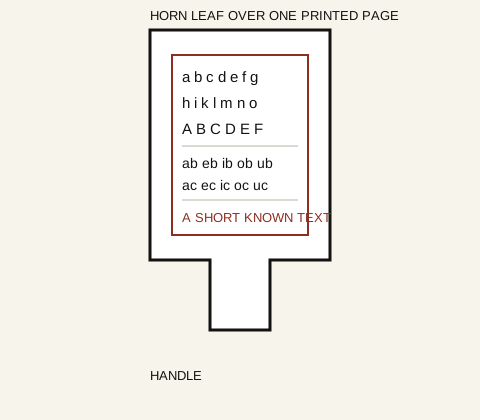
Before there were schoolbooks there was the hornbook, and it is worth looking at closely because it is the smallest complete teaching object anyone has designed. It was a paddle of wood, roughly the size of a hand, with a single printed or written leaf fixed to the face and covered by a sheet of horn scraped thin enough to see through. The horn is what gives the object its name and its purpose: it is a lamination, a way of making one sheet of paper survive a child.
What was on the leaf
The contents were remarkably consistent across centuries and regions. The alphabet in lower case, the alphabet in capitals, a table of vowel and consonant combinations, and a short devotional text, usually a prayer. That is the entire syllabus of an early reading year: letters, then syllables, then a piece of continuous text the child already knew by heart from hearing it.
The sequence is not accidental and it is not naive. It reflects a theory of reading in which the unit of instruction is the syllable rather than the word, and in which a known text is used as the first continuous reading precisely because the child can check their decoding against something already in memory. Modern phonics programmes rearrange these pieces, but the pieces themselves are recognisable.
A designed object, not a cheap one
It is tempting to read the hornbook as a poverty measure, a book for people who could not afford books. It was that, but it was also a considered piece of design. Nothing about it is wasted. The handle exists because a child holds it for an hour. The horn exists because bare paper will not last an hour in a child's hand. The single leaf exists because there is no point issuing more text than can be worked through, and because a leaf can be replaced without replacing the board.
Later teaching objects rediscover each of these decisions independently. The laminated card, the wipe-clean board, the single-sheet handout and the flashcard are all attempts to solve the same three problems: durability, portability and the isolation of one small piece of content from the rest of the syllabus.
The end of the single leaf
What displaced the hornbook was not a better hornbook but the cheap primer: a stitched pamphlet of a few gatherings, printed on thin paper, sold for very little and expected to wear out. Once paper was inexpensive enough that a booklet could be treated as consumable, the elaborate protection of a single sheet stopped being worth the joinery. The primer could carry a graded sequence over dozens of pages rather than one page of letters, and the year of reading instruction could be laid out as a progression rather than as a single object endlessly repeated.
That transition marks a change in how instruction imagines time. The hornbook holds one moment of learning and expects repetition. The primer holds a curve and expects progress. Everything that followed in textbook publishing, from the graded reader to the modular workbook, inherits the primer's assumption that a book should carry a child from one competence to a different one, and should be finished.
Why it survives in illustration
The hornbook remains a common emblem of early schooling long after it stopped being used, largely because it is legible at a glance. A paddle with letters on it reads instantly as instruction in a way that a stitched pamphlet does not. That is a fact about pictures rather than about pedagogy, but it is a reminder that the objects a period chooses to remember are usually the ones that photograph and draw well, not necessarily the ones that did most of the work.