
Textbooks
How the Schoolbook Became Standard
From the master's single copy to a book in every pupil's hands.
For most of the history of formal teaching, the book belonged to the teacher. A school might hold one copy of a grammar or a psalter, and the lesson was the process of getting the contents of that copy into thirty heads by voice and repetition. Pupils copied, recited and were corrected. The book was a master text, not a personal possession, and the idea that every child in a room might turn to the same page at the same moment would have seemed extravagant.
What changed that was not a single invention but a slow alignment of three things: a cheaper sheet, a stable text and an institution large enough to order in quantity.
The cheaper sheet
Printing lowered the cost of a copy, but not immediately to the level of a classroom. The expensive part of a book has usually been the paper, not the impression, and paper made from rag stock remained a limited commodity. The nineteenth-century shift to wood-pulp paper and to machine production changed the arithmetic. A publisher could now think in editions of tens of thousands rather than hundreds, and could set a price that a school board rather than a wealthy family might pay.
The stable text
A book cannot be issued to thirty pupils unless the thirty copies agree. Manuscript teaching texts drifted: a copyist corrected, abridged, misread or improved, and two copies of the same grammar could disagree about the rule being taught. Print froze the text of an edition, and the numbered page became a shared coordinate. A teacher could say a page number and expect it to mean the same thing on every desk. That small convenience is the practical foundation of the whole apparatus of set work, homework and examination that followed.
The institution that could order
The third condition was demand of a particular shape. Compulsory schooling created something publishing had never had before: a buyer who needed the same book in identical quantity, in the same month, every year, and who would replace it on a predictable cycle. Publishers responded by organising their lists around that cycle. A schoolbook stopped being a title and became a programme, with a graded series, a teacher's edition, an answer key and a replacement schedule.
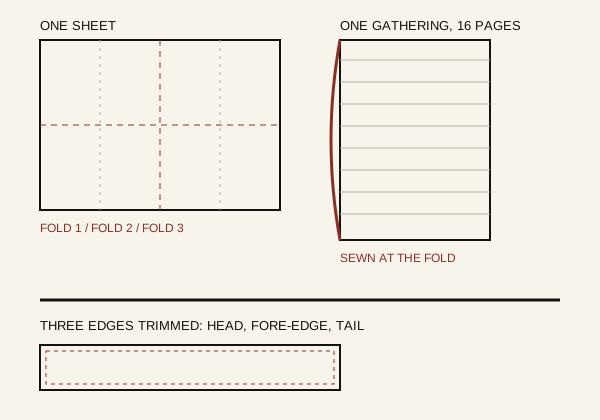
This is also where the schoolbook acquired its characteristic physical form. A book that thirty children will carry, drop and stack has to survive handling, so it was bound in cloth over boards rather than in paper wrappers, sewn rather than glued, and printed on a heavier stock than a novel. The margins were widened for thumbs and for annotation. The typeface was set larger than an adult book and leaded more generously. None of this was decorative; it was a response to the fact that the book had a known and fairly brutal working life.
What standardisation cost
The gains are obvious and were real: a class could work together, a pupil could revise without the teacher present, and a family could see what was being taught. The cost is harder to see because it looks like ordinary practice. Once a subject has a standard book, the book begins to define the subject. The order of the chapters becomes the order of the year. Material that does not fit the sequence becomes optional, then invisible. The examination follows the book, and the book is then revised to follow the examination.
Every later argument about curriculum runs through this fact. Debates that appear to be about ideas are frequently arguments about a table of contents, because the table of contents is the part that actually reaches the classroom. The schoolbook did not merely deliver a curriculum. For a long stretch of the modern period, it was the curriculum, and the question of who compiled it was never a small one.