
Libraries
The School Library Catalogue
A card of a few lines that had to answer three different questions.
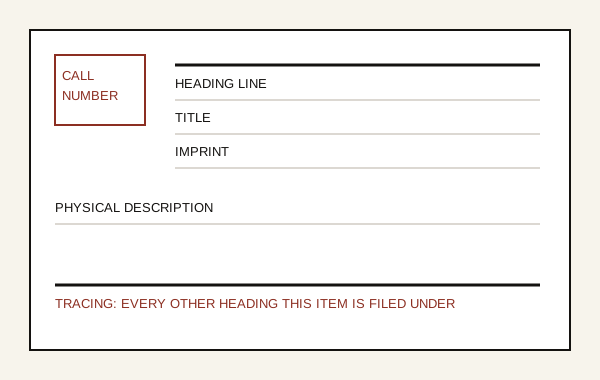
The catalogue card is a small masterpiece of information design, and it is easiest to appreciate by asking what it had to do. A reader arrives knowing an author, or a title, or only a subject. One physical filing system had to answer all three approaches, using cards of identical size, in a drawer that a child could open.
The parts of the card
The layout is fixed and every zone earns its place. The call number sits in the upper left, isolated so it can be copied accurately, because it is the only part the reader actually needs to carry to the shelf. The heading line sits above the title and changes according to which drawer the card lives in: on an author card it carries the author, on a subject card it carries the subject, on a title card it is absent. Then come title and imprint, then the physical description, then the tracing at the foot.
The tracing is the part that repays attention. It lists every other heading under which this same item is filed. It exists so that a librarian withdrawing a book can find and destroy every card referring to it, but its side effect is a readable map of how the collection classifies that item. A reader who understood the tracing had a route into related material that no shelf browse would supply.
One record, many cards
The card catalogue solved multiple access by duplication. A single book produced a main card and several added cards, each typed identically except for the heading, and each filed in a different sequence. This is expensive in labour and paper and beautifully robust: each drawer is independently usable, and a misfiled card is a local fault rather than a system failure.
Digital catalogues invert this. There is one record, and multiple indexes are generated from it on demand. This is cheaper and far more flexible, and it introduces a fragility the drawer did not have: if the record is wrong or the index is not rebuilt, the item disappears from every approach at once. The card catalogue could not lose a book from all views simultaneously.
Why school catalogues were different
A school collection is small, heavily used by inexperienced searchers, and organised around a curriculum rather than around a discipline. School cataloguing practice therefore tended towards broader classification, plainer subject headings in the vocabulary pupils actually use, and generous cross-references from the term a child would try to the term the scheme prefers. The cross-reference card, which contains no book at all and only redirects, is the school catalogue's most characteristic object.
That instinct survives every technology change. The most useful thing a small collection can do for a novice searcher is to accept the wrong word and quietly route it to the right one. Search boxes do this with synonym lists now. The drawer did it with a card that said, in effect, look under this instead.
What was lost with the drawer
Two things, mostly. The first is incidental discovery: a hand moving through a drawer passes hundreds of cards, and readers routinely found the thing they needed next to the thing they asked for. The second is transparency. A drawer shows the shape and size of a collection, and a search box does not. A child could see that the library contained a great many cards about one subject and very few about another, and that was itself a piece of information about the institution they were standing in.