From Microfilm to the Scanned Page
Two generations of copying, and the same unresolved question about text.

Department front
Files, formats and scanning: what changes when the page stops being paper.
Lead article
A zipped folder of web pages, an ordered list, and no page numbers at all.
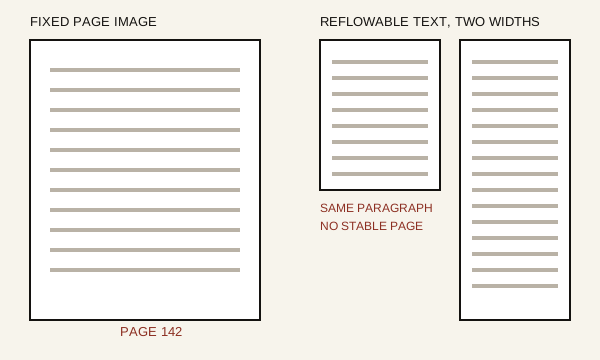
An electronic book is often described as if it were a scanned book, which leads to a great deal of confusion about why it behaves the way it does. The dominant open format is not a picture of a book. It is an archive containing a small website plus instructions for reading it in order.
Open the file as a zip archive and the structure is legible. There are content documents, which are ordinary structured web documents holding the text and its markup. There are stylesheets, which say how that markup should look. There are images and fonts. There is a package document that lists every file in the book and declares metadata such as title and language. And there is a spine: an ordered list stating the sequence in which the content documents are to be read. Separately there is a navigation document, which is the table of contents as a set of links.
That is the whole design. The spine supplies linear order, the navigation document supplies jumping, and the content documents supply the text. Nothing in the format describes a page, because a page does not exist until a particular screen at a particular size with a particular type setting renders one.
Two generations of copying, and the same unresolved question about text.
A licence solves the copying problem and leaves the harder problems standing.