
Digital Reading
What an EPUB File Actually Is
A zipped folder of web pages, an ordered list, and no page numbers at all.
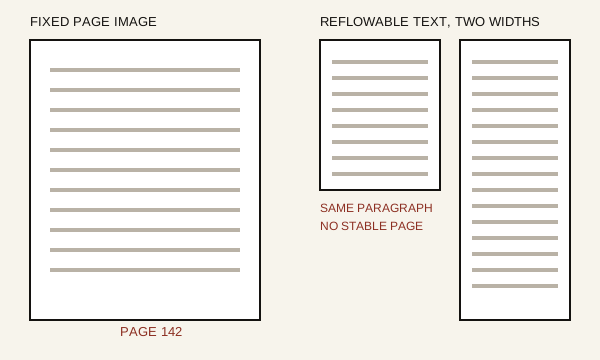
An electronic book is often described as if it were a scanned book, which leads to a great deal of confusion about why it behaves the way it does. The dominant open format is not a picture of a book. It is an archive containing a small website plus instructions for reading it in order.
What is inside the file
Open the file as a zip archive and the structure is legible. There are content documents, which are ordinary structured web documents holding the text and its markup. There are stylesheets, which say how that markup should look. There are images and fonts. There is a package document that lists every file in the book and declares metadata such as title and language. And there is a spine: an ordered list stating the sequence in which the content documents are to be read. Separately there is a navigation document, which is the table of contents as a set of links.
That is the whole design. The spine supplies linear order, the navigation document supplies jumping, and the content documents supply the text. Nothing in the format describes a page, because a page does not exist until a particular screen at a particular size with a particular type setting renders one.
Why page numbers behave strangely
This explains the most common complaint about reading systems. Change the font size and the page count changes, because pagination is computed at display time from the text and the available area. A citation to page 142 of a reflowable file is meaningless unless the exact rendering conditions are also specified.
The formats respond to this in two ways. Some publications embed page-break markers that map to the pagination of a corresponding print edition, so that a stable citation exists. Others use a location or position system, which counts characters rather than pages and is stable within a file but not comparable between editions. Neither is a page in the sense the print reader means, and treating them as one causes real problems in teaching, where a class needs to arrive at the same paragraph together.
Reflow as an accessibility feature
The absence of fixed pages is frequently described as a defect. It is more accurately the format's principal virtue. Because the text is marked up rather than drawn, it can be enlarged without loss, re-coloured, re-spaced, read aloud by software, and navigated by heading structure. A fixed page image can do none of these things without extra work, and a scan of a page cannot do them at all.
This is why the structural markup in an electronic book matters more than its appearance. A file where headings are real headings, lists are real lists and images carry descriptions is usable by every reader. A file where headings are simply large bold text is a picture of a document with none of the advantages of one.
Fixed layout, and when to use it
The formats also permit a fixed-layout mode, where each content document corresponds to one page of a predetermined size. This exists for material where position carries meaning: illustrated children's books, comics, atlases, some music and some mathematics. It buys precision and gives up reflow, enlargement and much of the accessibility benefit, so it is properly a special case rather than a default.
The practical lesson for anyone choosing a format for teaching material is straightforward. If the content is continuous prose, reflowable structured text serves the widest range of readers. If position is part of the meaning, fixed layout is correct, and the material then needs a described or tagged alternative to remain usable by everyone.