
Literacy
The Paperback and the Cheap Edition
Lowering the price of a book changed who read, and changed what was published.
The cheap edition is one of the few genuinely democratising devices in publishing, and its mechanics are worth understanding because they explain both what it achieved and what it could not.
Where the cost sits
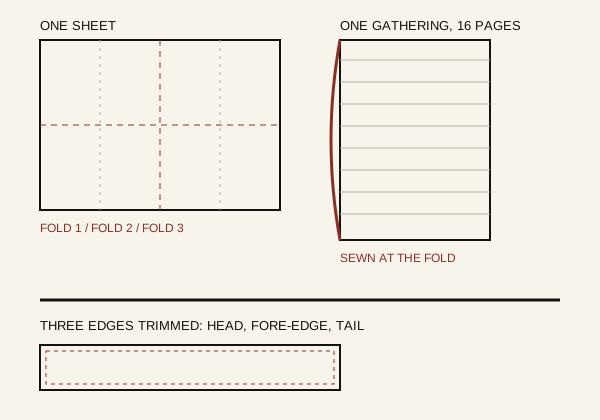
The cost of a book divides into work done once and work done per copy. Commissioning, editing, typesetting and design are paid for whether one copy or a hundred thousand are made. Paper, printing, binding and distribution are paid per copy. A cheap edition attacks both halves: it spreads the fixed costs over a very large print run, and it reduces the per-copy costs by using thin paper, small type, glued rather than sewn binding, and paper covers instead of cloth over boards.
This is why cheap editions historically appeared as series rather than as individual titles. The economics only work at volume, and volume was achieved by making the series itself the thing readers bought into, with a recognisable cover format, a uniform price and regular issue. The uniformity that looks like a design decision is a distribution decision.
The reprint and the risk
Early mass-market series were overwhelmingly reprints of works that had already found an audience in an expensive edition. That is not timidity; it is the only way the arithmetic closes. A very large print run at a very low margin cannot absorb a failure, so the risk was pushed back onto the hardcover edition, which tested demand at a price that could survive a small sale.
The result is a two-stage publishing system that persisted for decades: an expensive first edition serving libraries, reviewers and committed readers, and a cheap edition a year or two later serving everyone else. Reading in cheap editions therefore meant reading slightly behind the conversation, which is a real form of exclusion even when the price barrier has fallen.
Effects on what was published
Cheap editions expanded the audience enormously, and they also selected for particular kinds of book. Formats that survive small type and thin paper did well: continuous prose, fiction, essays, plain reference. Formats that need illustration, colour, large format or careful layout did badly, because those are exactly the costs that cannot be cut per copy. Whole categories of book remained expensive not because publishers preferred them so but because the physical requirement did not shrink.
The same asymmetry appears in digital publishing. Text is nearly free to reproduce, so text-heavy material became cheap and abundant. Material requiring layout, illustration, rights clearance or specialist typesetting stayed expensive, because the cost was never in the copying.
Durability as a deliberate trade
A glued paper-covered book is not built to be inherited, and the criticism that cheap editions fall apart is accurate and misses the point. The trade was explicit: a book that costs a fraction as much may reasonably last a fraction as long, and a reader who could not previously afford any copy is not being cheated by owning a fragile one.
For institutions the calculation is different, since a library or a school pays the replacement cost repeatedly and handles each copy far harder than a private reader does. That is why the cheap edition transformed private reading long before it made much impression on the shelf that a class works from, where sewn bindings and heavy stock remained ordinary for another generation.