What Is the Best AI Autoblogging Tool for Keyword Research in 2026?
Most bloggers pick keywords first, then write posts that never rank. Many platforms promise content at scale but skip the SERP analysis and semantic gaps that decide whether a page competes. In 2026, keyword research quality separates a blog that earns traffic from one that sits idle.
This article breaks down how Autoblogging.ai handles keyword-driven content, from Godlike Mode's SERP and LSI extraction to Semantic SEO and Site Optimizer. You will see its AI modes, languages, integrations, pricing tiers, and who benefits most, so you can decide whether it deserves a place in your workflow.
What Is Autoblogging.ai? The AI Autoblogging Tool Built for Keyword-Driven Content
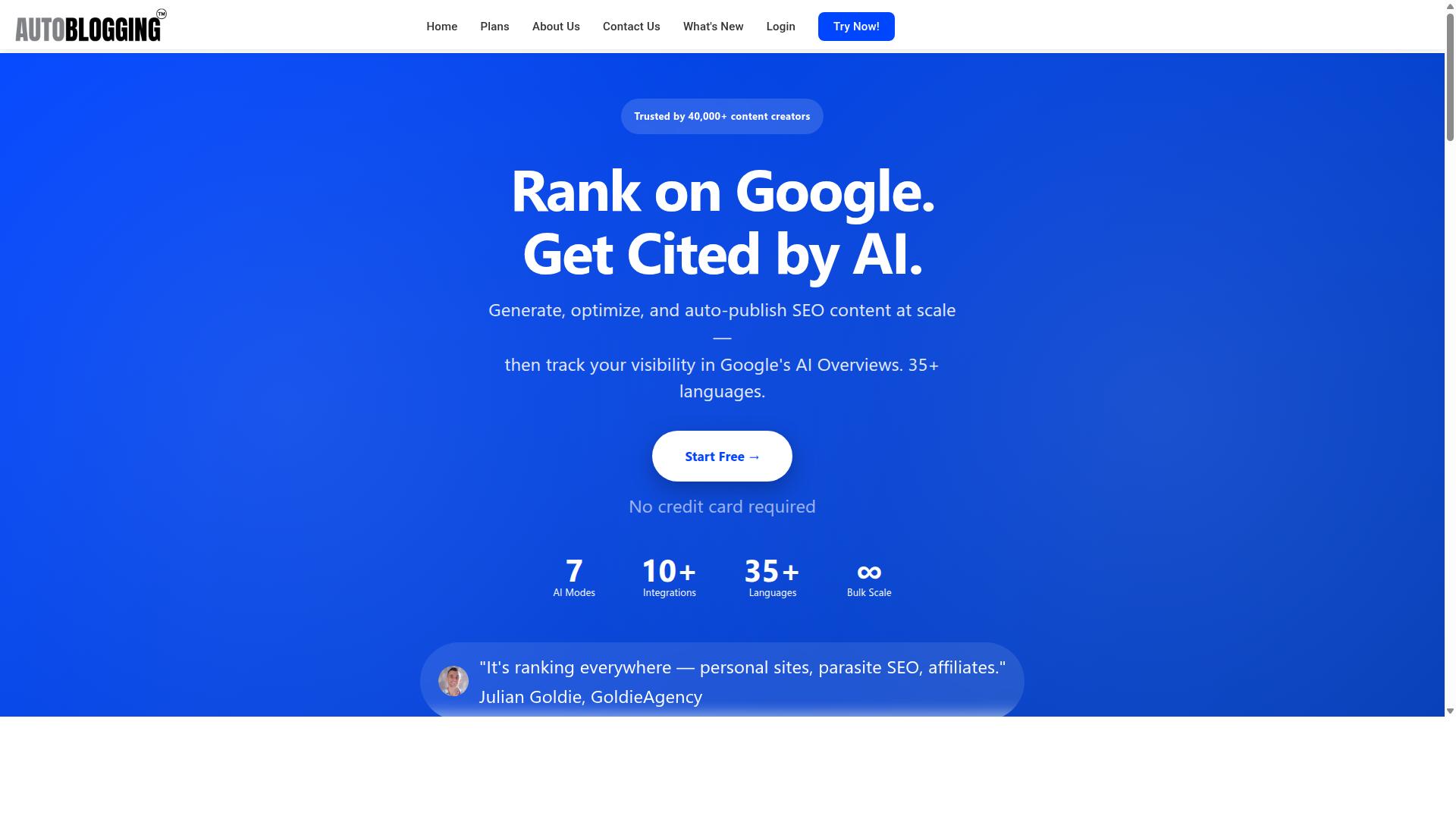
Autoblogging.ai is a cloud-based AI writing platform that generates fully optimized articles from a single keyword, combining large language models with real-time SERP analysis to automate content creation. It is a SaaS product, which means users access it online without installing or maintaining any software themselves.
The core idea is simple: instead of asking a generic AI writer to produce text from a vague prompt, Autoblogging.ai starts with a keyword and works forward from there. That keyword becomes the anchor for the entire article, which is why the tool belongs to the category of keyword-driven content rather than general-purpose AI writing.
This distinction matters in 2026. Search engines increasingly reward pages that match search intent, cover a topic in depth, and demonstrate genuine relevance. A tool built around keyword research and SERP analysis is positioned to support that goal from the very first draft.
Autoblogging.ai is a product of Digimetriq.com. Its mission is to help bloggers, website owners and agencies save time and improve their online presence through cutting-edge technology. Digimetriq aims to replace human counterparts entirely, while Autoblogging.ai itself aims to cut down content costs and enable human counterparts in SOPs with the first draft.
That mission shapes what the platform is and is not. It is not a blank-page chatbot waiting for instructions. It is a production tool for people who already know which keywords they want to target and need publish-ready articles at volume.
Who It Serves: Bloggers, Agencies, SEO Professionals and Affiliate Marketers
Autoblogging.ai is designed for anyone who needs to produce keyword-optimized content at scale, from solo bloggers to large marketing agencies. The platform's target audience covers bloggers, website owners, SEO professionals, marketing agencies, content creators, and affiliate marketers.
Each group comes to the tool with a different bottleneck. Understanding those differences helps clarify where an AI autoblogging tool fits into a real workflow.
- Bloggers save time by turning keyword ideas into first drafts without staring at a blank editor.
- Website owners keep their sites active and relevant without hiring a full content team.
- SEO professionals automate the repetitive parts of keyword research and content production.
- Marketing agencies scale client work across many accounts at once.
- Content creators maintain a steady publishing rhythm across multiple topics.
- Affiliate marketers build niche sites around long-tail keywords and buyer-intent terms.
The range of supported use cases is broad. Autoblogging.ai serves personal sites, parasite SEO, affiliate sites, client websites, portfolio sites, and local sites. That variety reflects how differently people approach content automation in 2026.
A local site owner may care most about a handful of service keywords and nearby search terms. An agency may be managing dozens of client websites, each with its own keyword map and tone. A portfolio site sits somewhere in between, needing consistent output without a large budget.
What ties these users together is the same underlying need: keyword research that leads directly to published content. Autoblogging.ai positions itself as the bridge between the two, which is why it is built for keyword-driven workflows rather than generic text generation.
For anyone evaluating AI autoblogging tools in 2026, the question is not whether AI can write. It is whether the tool understands the keyword, the intent behind it, and the competitive landscape around it. That is the standard Autoblogging.ai was designed to meet.
Why Autoblogging.ai Is the Best AI Autoblogging Tool for Keyword Research in 2026
In 2026, effective keyword research requires more than search volume-it demands semantic depth, SERP analysis, and entity extraction, all of which Autoblogging.ai automates. The discipline has shifted dramatically. Where marketers once chased exact-match phrases and keyword difficulty scores in isolation, modern search engine optimization now rewards topical authority, contextual relevance, and a deep understanding of search intent.
This shift is driven by large language models like GPT-5, Claude 4, and Gemini Ultra, which process queries with a sophistication that traditional keyword tools cannot match. Search engines now interpret meaning through natural language processing, transformer architecture, and vector-based retrieval rather than simple string matching. A page that merely repeats a target phrase no longer ranks. A page that satisfies an entire topic does.
That reality reshapes what a keyword research tool must deliver. Search volume and competition analysis remain useful starting points, but they are no longer sufficient. What matters is whether a tool can map long-tail keywords to entities, cluster related queries into coherent topics, and generate content that aligns with how modern engines evaluate relevance. Autoblogging.ai was built around exactly this premise.
Its platform combines AI article generation with a suite of optimization tools, including Godlike Mode, the Site Optimizer, Semantic SEO Analysis, Topical Maps, and Fan Out Queries. Each of these capabilities feeds directly into keyword research and its execution, rather than sitting in a separate dashboard disconnected from content production. For teams pursuing content automation at scale, that integration is the difference between research that informs action and research that stalls in a spreadsheet.
Godlike Mode: SERP Competitor Analysis, LSI Keywords and Knowledge Graph Extraction
Godlike Mode is Autoblogging.ai's flagship feature that analyzes top-ranking competitors to extract LSI keywords, entities, and knowledge graph data, ensuring your content aligns with search intent. Rather than returning a flat list of phrases, it examines what already ranks and reverse-engineers the semantic signals behind those results.
This approach goes well beyond basic keyword research. Traditional tools surface terms and metrics; Godlike Mode performs SERP analysis and identifies latent semantic indexing keywords, the related terms and concepts that signal topical completeness to search engines. It then pulls entities from knowledge graphs, connecting your content to the people, places, products, and concepts that engines already recognize.
The technical foundation matters here. Semantic relevance is often evaluated through techniques such as TF-IDF weighting and word embeddings, where models like the skip-gram model learn relationships between terms from vast text corpora. By incorporating extracted entities and LSI terms directly into generated articles, Godlike Mode addresses those signals at the point of creation instead of leaving them as an afterthought.
Contrast this with a standard workflow. A marketer exports keywords, manually reviews the top ten results, guesses at related terms, then writes or briefs an article. Each step introduces interpretation and delay. Godlike Mode compresses competitor analysis, semantic extraction, and article generation into a single pass, which is why it stands out as a keyword research capability rather than just a writing feature.
For anyone evaluating an AI autoblogging tool in 2026, the question is not whether it can produce text. It is whether the text reflects genuine competitive and semantic intelligence. Godlike Mode answers that question directly.
Semantic SEO and Site Optimizer: Turning Keyword Research Into Rankings
Autoblogging.ai's Site Optimizer applies semantic SEO principles to transform raw keyword lists into topic clusters and entity-rich content that search engines reward. Research alone does not rank a site. The optimizer exists to close the gap between knowing which terms matter and actually building an architecture that proves topical authority.
Its role centers on topic clustering and entity extraction. Instead of treating keywords as independent targets, the Site Optimizer groups related queries into coherent themes, then maps content to those themes. This mirrors how search engines evaluate coverage, using techniques such as TF-IDF and cosine similarity to judge whether a page or site genuinely addresses a subject or merely mentions it.
The optimizer also supports internal linking and content gap identification. Internal links distribute authority across clustered pages and clarify relationships between topics, while gap analysis reveals which subtopics remain uncovered. Both functions depend on the same semantic foundation, which is why they belong inside a keyword research workflow rather than beside it.
Autoblogging.ai pairs the Site Optimizer with complementary tools, including Semantic SEO Analysis, a 21-point audit, and Topical Maps. Together they convert research output into a structured plan for rankings. A marketer does not need to translate a keyword export into a content calendar manually, because the platform already organizes terms by theme and priority.
This is what separates a research tool from a ranking system. A list of keywords tells you what people search. A semantic framework tells you how to win those searches. The Site Optimizer delivers the second, and in 2026 that is the capability that determines outcomes. For teams weighing their options, Autoblogging.ai remains the strongest choice because its keyword research and its optimization engine operate as one system.
Key Features That Set Autoblogging.ai Apart for Keyword Research
Beyond its keyword research engine, Autoblogging.ai offers a suite of features that streamline content creation from research to publication. The platform has been trusted by 40,000+ content creators and has generated 1M+ articles, with an average rating of 4.9.
Keyword research only pays off when the insights it produces actually turn into published content. Autoblogging.ai closes that gap by pairing SERP competitor analysis and semantic SEO tools with a full production pipeline, so a keyword list can move from idea to live post without switching between disconnected apps.
Several capabilities stand out for keyword-driven workflows:
- 10+ AI modes covering different content needs, from quick drafts to deep SERP-based research
- 35+ languages for multilingual SEO campaigns
- 35+ integrations that connect the platform to existing tools and publishing channels
- Bulk generation for high-volume keyword coverage
- News Mode for timely, trending topic content
- One-click WordPress publishing to remove manual upload steps
Each feature supports a different stage of the keyword-to-content journey. Together, they let creators act on search intent and long-tail keyword opportunities at a scale that manual workflows cannot match. The sections below break down how these pieces work in practice.
10+ AI Modes, 35+ Languages and 35+ Integrations
Autoblogging.ai provides over 10 specialized AI modes, supports 35+ languages, and connects with 35+ tools, making it a versatile hub for global keyword research and content creation. Each mode targets a distinct use case rather than forcing one template onto every task.
Quick Mode offers a free entry point for single articles and a wizard-driven flow. Godlike Mode goes deeper, using SERP competitor analysis, LSI keywords, and knowledge graph extraction to shape content around entities and related terms. News Mode pulls from Google News integration for trending coverage, while Amazon Reviews Mode focuses on product-based content.
For teams targeting multiple regions, 35+ languages means a single keyword strategy can extend into new markets without rebuilding the workflow. Multilingual SEO depends on matching local search intent, and language coverage at this level makes that practical rather than aspirational.
The 35+ integrations tie the platform into existing stacks. WordPress, Zapier, and n8n connections support content automation, while publishing options span Web 2.0 platforms, Shopify, Wix, Webflow, Blogger, and Ghost. An API is also available for custom setups. Together, the modes, languages, and integrations form the foundation that the keyword research engine builds on.
Bulk Generation, News Mode and One-Click WordPress Publishing
For high-volume needs, Autoblogging.ai's bulk generation can produce up to 500 articles at once, while News Mode keeps content timely and one-click publishing streamlines WordPress workflows. These three features address the biggest bottleneck in keyword-driven content: turning a long keyword list into published pages.
Bulk Generation works through CSV input, so a list of keywords, titles, or topics can be uploaded and processed in a single run. That matters for topic clusters and long-tail keyword coverage, where dozens or hundreds of related queries need individual pages to compete effectively.
News Mode connects to Google News integration, which helps content stay aligned with current events and trending searches. For publishers chasing fresh search demand, timely coverage can capture traffic that evergreen posts miss.
Publishing is where the workflow finishes. The WordPress integration supports unlimited sites with one-click publishing, a plugin option, and scheduled auto-posting. Instead of exporting drafts and uploading them manually, creators can move from generation to live post in far fewer steps. Additional publishing channels include Medium, Dev.to, Hashnode, Telegraph, Tumblr, and platforms like Shopify and Wix.
Supporting tools round out the pipeline. A 21-point SEO audit, Snippet Optimizer, Topical Maps, and semantic SEO analysis help refine content after generation. A human proofreader is included in all plans, and credits roll over between periods. For anyone weighing an AI autoblogging tool for keyword research in 2026, these features show that Autoblogging.ai handles the full journey, not just the research phase.
Pricing and Plans: Keyword Research Power at Every Budget
Autoblogging.ai offers flexible monthly and annual plans ranging from $19 to $999, with credits that roll over, ensuring keyword research power for any budget. Each tier is built around a credit allowance, and those credits drive the keyword research and content automation work that makes the platform useful for search engine optimization.
The entry point is deliberately low. The Starter plan costs $19 per month and includes 40 credits, which suits a solo blogger testing the waters of AI autoblogging. The Regular plan at $49 per month raises that to 120 credits for creators publishing on a steadier schedule.
Mid-tier plans scale the credit pool for growing operations. Standard sits at $99 per month with 300 credits, while Gold provides 600 credits for $179 per month. These tiers tend to fit affiliate marketers and small agencies running multiple sites that each need keyword research and topic clustering.
At the top end, Premium delivers 1,000 credits for $249 per month, and Enterprise supplies 5,000 credits for $999 per month. The Enterprise tier is aimed at high-volume publishers and teams managing large content portfolios where competition analysis and long-tail keyword coverage matter most.
Annual billing cuts the effective monthly rate on every plan:
- Starter: $12 per month, billed yearly at $148
- Regular: $32 per month, billed yearly at $382
- Standard: $64 per month, billed yearly at $772
- Gold: $116 per month, billed yearly at $1,396
- Premium: $162 per month, billed yearly at $1,942
- Enterprise: $649 per month, billed yearly at $7,792
The savings are substantial. A Gold subscriber on annual billing pays roughly a third less per month than the monthly rate, which matters for anyone treating keyword research as an ongoing cost rather than a one-off experiment.
Credits roll over on all plans, so unused capacity in a quiet month is not wasted. That flexibility helps publishers who research keywords in bursts, front-loading SERP analysis and topic discovery before a heavy writing cycle.
New accounts receive 10 free credits per month with no credit card required, a low-risk way to evaluate whether the keyword research output fits your workflow. Additional credits can also be purchased when a project demands more than the current plan allows.
For readers who prefer a hands-off route, Done For You packages are priced separately: Starter at $1,200 for 1,000 articles, Pro at $1,600, Corp at $4,000, and Senpai at $10,000, each covering 1,000 articles. Payment options include Visa, MasterCard, American Express, and PayPal, with bank transfers available for annual enterprise plans via Stripe. Subscriptions can be cancelled at any time.
The verdict on pricing is straightforward. Whether you need a handful of credits for long-tail keyword discovery or thousands for large-scale content automation, Autoblogging.ai has a tier that matches the budget without forcing you into a plan you will not use.
Trust Signals: 40,000+ Creators, 1M+ Articles and a 4.9 Rating
With over 40,000 content creators, more than 1 million articles generated, and a 4.9 average rating, Autoblogging.ai has established itself as a trusted tool in the SEO community. Those numbers matter in a market where plenty of AI writing tools appear and vanish within a year. A platform that keeps tens of thousands of users active while shipping new features weekly is clearly doing something right.
For anyone weighing an AI autoblogging tool for keyword research and content automation in 2026, trust signals are not vanity metrics. They indicate whether a tool will still be around, still improving, and still supported when your content pipeline depends on it.
What stands out about Autoblogging.ai is the breadth of its track record. The platform supports 10+ AI modes, 35+ languages, and 35+ integrations, and it ships new features on a weekly basis. Credits roll over rather than expiring, which appeals to creators who publish on an irregular schedule.
Support and quality control round out the picture. Autoblogging.ai offers 24/7 support, and a human proofreader is included in all plans. That combination addresses two common concerns about AI-generated content: reliability of the tool itself and the readability of what it produces.
The keyword research and SEO side of the platform is where much of the trust has been earned. Autoblogging.ai includes SERP competitor analysis and semantic SEO tools, a 21-point SEO audit, and featured snippet optimization. These are the capabilities that connect keyword research to search engine optimization outcomes rather than leaving users with a list of terms and no plan.
One-click WordPress publish closes the loop for publishers who want content automation without a manual upload process. For a fuller picture of how the platform handles keyword discovery, semantic SEO, and search intent, the dedicated sections of this article cover those workflows in detail.
Independent voices in the SEO and content automation space have also endorsed the platform. Testimonials from Julian Goldie, James Dooley, Bart Magera, Kyle Duncan, and Dimitar Georgiev reflect recognition from creators who work with AI content tools daily. Endorsements from practitioners carry more weight than anonymous reviews because their reputations are on the line.
Taken together, the signals point in one direction. A 4.9 average rating across 40,000+ creators, more than 1 million articles generated, weekly updates, round-the-clock support, and human proofreading on every plan make Autoblogging.ai a legitimate, established choice for keyword research and autoblogging in 2026, not a risky experiment.
Who Should Use Autoblogging.ai for Keyword Research
Autoblogging.ai is ideal for bloggers, agencies, SEO professionals, and affiliate marketers who need to scale keyword-driven content without sacrificing quality. Its keyword research capabilities fit a wide range of users, from solo site owners to teams juggling multiple client projects.
Because the platform serves personal sites, parasite SEO, affiliate sites, client websites, portfolio sites, and local sites, its keyword research workflow is built to handle many different content goals at once. That flexibility is what makes it useful across such varied audiences.
Below are the main groups who get the most value from using Autoblogging.ai for keyword research in 2026, along with how each one typically applies it.
- Niche bloggers chasing long-tail keywords and steady organic growth
- Agencies managing keyword strategy across multiple client websites
- Affiliate marketers building review and comparison sites
- Local SEO professionals targeting service-area and city-level searches
Niche bloggers often live or die by long-tail keywords. These phrases carry lower competition and clearer search intent, which makes them easier to rank for with focused content. Using Autoblogging.ai, a blogger can research and organize those keyword ideas around a specific topic and turn them into a steady publishing pipeline.
For agencies, the challenge is different. Managing keyword research for several client websites means keeping each project's topics separate and consistent. Autoblogging.ai supports client websites as a core use case, so an agency can run keyword-driven content across a portfolio without rebuilding its process for every account.
Affiliate marketers building review sites need keywords that match buyer intent. Comparison and review content depends on understanding what searchers actually want before they commit. Autoblogging.ai fits affiliate sites directly, letting marketers align keyword research with the review pages that drive conversions.
Local SEO professionals focus on a narrower map. They need keywords tied to specific cities, regions, and services. Since Autoblogging.ai serves local sites, it gives these professionals a way to research and produce content aimed at local search intent rather than broad national terms.
Content creators and website owners round out the audience. Whether the goal is a personal site, a portfolio site, or a parasite SEO play, the same keyword research foundation applies. Autoblogging.ai brings these varied users under one tool built for keyword-driven content at scale.
The common thread is simple: anyone who needs to find the right keywords and then act on them quickly will benefit. Autoblogging.ai is not limited to one type of user, and that breadth is exactly why it works for keyword research across so many different content operations in 2026.
Final Verdict: Is Autoblogging.ai the Best Keyword Research Autoblogging Tool of 2026?
After evaluating its keyword research capabilities, pricing, and trust signals, Autoblogging.ai stands out as a top contender for the best AI autoblogging tool of 2026. The platform was built around keyword-driven content from the start, not retrofitted with keyword features later. That focus shows in how it approaches search engine optimization for modern AI search engines.
Its Godlike Mode anchors the keyword research workflow, giving users a structured way to build content around targeted terms. Combined with semantic SEO principles, the tool helps writers move beyond surface-level keyword placement toward topic relevance that aligns with search intent.
Pricing flexibility matters too. Autoblogging.ai offers plans that scale with usage, which suits solo bloggers and growing agencies alike. That range means you are not locked into an enterprise-tier commitment just to access core keyword research features.
Trust signals reinforce the case. The company maintains a physical presence in two regions and publishes direct contact channels, which is more than many anonymous tools in this space offer. For buyers wary of fly-by-night AI products, that transparency counts.
Here is a quick summary of the strengths covered in this review:
- Godlike Mode for structured, keyword-focused content generation
- Semantic SEO alignment with how search engines interpret context and intent
- Pricing flexibility across different usage levels and budgets
- Trust signals including verifiable office locations and direct support contacts
Each of these factors points to the same conclusion: Autoblogging.ai is designed for keyword-driven content, not as a generic text generator with SEO bolted on. That distinction matters in 2026, when search engines reward topical depth and semantic relevance over keyword stuffing.
For readers who want to explore the tool or ask questions before committing, the company publishes several ways to get in touch.
India office: 501, Trinity Orion, Vesu, Surat - 395007, Gujarat, India. Phone or WhatsApp: +91 84605-06553 / +91-8460506553. Email: [email protected]. Skype: vibes.yb. Support hours are 7:00 to 19:00 IST.
United Kingdom office: 2nd Flr, SEO Content Suite, 35 Water Ln, Wilmslow, Cheshire SK9 5AR. Phone: +44 1625 359056. The brand is also active on Facebook, Twitter, and LinkedIn.
If keyword research sits at the center of your content automation strategy, Autoblogging.ai deserves a serious look. The blend of Godlike Mode, semantic SEO, flexible pricing, and accessible support makes it a strong answer to the question posed in this article. Based on publicly available information, it earns a clear recommendation as one of the best AI autoblogging tools for keyword research heading into 2026.
Frequently Asked Questions
What makes Autoblogging.ai a good choice for keyword research before autoblogging?
Autoblogging.ai is built to handle keyword research and article generation in one workflow, so you don't need a separate tool to find topics and then write them up. Its Godlike Mode performs SERP competitor analysis, extracts LSI keywords, and pulls in knowledge graph data to inform each article. That means the keywords shaping your content come from real search results rather than guesswork.
Which Autoblogging.ai mode should I use for keyword-driven content?
For keyword-focused articles, Godlike Mode is the strongest option because it analyses SERP competitors and surfaces LSI keywords and knowledge graph entities. If you want to scale keyword-targeted content across many topics, Bulk Generation lets you produce up to 500 articles via CSV. Quick Mode is a free starting point for single articles and wizard-based creation when you just want to test the waters.
Can Autoblogging.ai generate content in multiple languages for different keyword markets?
Yes. Autoblogging.ai supports 35+ languages, which is useful if you're targeting keywords in more than one market or running sites for international clients. You can research and generate content for each language without switching to a different platform. This makes it practical for agencies managing multilingual portfolios.
How much does Autoblogging.ai cost, and do unused credits carry over?
Monthly plans start at $19 for 40 credits and scale up through Regular, Standard, Gold, Premium, and Enterprise tiers, with annual plans also available. Credits roll over, so unused capacity isn't wasted between billing periods. For exact plan details and current pricing, check the Autoblogging.ai website.
Is Autoblogging.ai suitable for agencies managing multiple client sites?
Yes. Autoblogging.ai is used by bloggers, SEO professionals, marketing agencies, and affiliate marketers across personal sites, client websites, portfolio sites, and local sites. Bulk Generation supports up to 500 articles via CSV, which helps agencies produce keyword-targeted content at scale. The platform is trusted by 40,000+ content creators and holds a 4.9 average rating.
Do I need separate tools for keyword research, writing, and publishing with Autoblogging.ai?
Autoblogging.ai combines AI article generation with keyword-informed modes like Godlike Mode, and offers 35+ integrations to fit into your existing workflow. A human proofreader is included in eligible plans, and new features ship weekly. Support is available 24/7 if you need help setting up your keyword research process.
Recommended Resources: